- Around 1905, an English cleric developed a hybrid English Missal that combined Cranmerian prayers with an English version of the Latin Tridentine text, which was used in some English Anglo-Catholic parishes. (However, this liturgy had no official sanction and was used only because Anglican bishops looked the other way; they also looked the other way when other clerics denied the Creeds. In addition, other versions of hybrid missals were in use elsewhere, with equivalent lack of sanction.)
- By the 1930s, other Anglo-Catholics or Anglo-Papalists (Fr Hunwicke is not precise in using these terms) decided the Missale Romanum was the truly lawful book of the Western Latin Church of which they felt they were members; the English Missal was a way of working towards that ideal. This view can most charitably be characterized as eccentric, since it was not sanctioned by Rome (which would probably have said on one hand, we can't stop you from using this as you please, but on the other, you should really simplify things and formally become Catholic); neither was it sanctioned by York or Canterbury. However, York and Canterbury had long since established the precedent that its clerics could get away with worse.
- Anglo-Papalist clergy were persecuted (I assume very occasionally) nevertheless for using a liturgy without sanction. Ah, the humanity! (By 1920, however, Frederick Kinsman wrote that while he never had an instance of having to discipline clergy for departures from usage while he was Bishop of Delaware, the general custom in both the Church of England and PECUSA would have required him, in the interest of uniformity, to do nothing.)
- Vatican II resulted in liturgical reform, but not in a direction Anglo-Papalists expected. However, the Anglo-Papalists were under York and Canterbury, not Rome. Nevertheless, in a remarkable Jedi-Jesuit mind trick, Rome forced them to stop using their hybrid missal, which in fact was sanctioned nowhere! Instead, although Fr Hunwicke raises this only by implication, Anglo-Papalists in the Church of England went to the Novus Ordo mass, with CofE bishops presumably continuing to look the other way.
- However, under Anglicanorum coetibus, Rome has spoken, and the particular UK version of the hybrid liturgy, dating from 1905 or so, can now be used in Catholic parishes. (The evidence we see is that, when it's been introduced in the UK Ordinariate, the parishioners have rejected it and instead have moved to Novus Ordo diocesan masses. Evidence from North America is more fragmentary, but the Ordinariate there is not thriving by any stretch.)
Tuesday, July 7, 2015
"Anglcan Patrimony" Again
Fr Hunwicke has concluded his series of posts on the liturgy, and I'm mainly confused, since he seems to be appealing to a "principle" that I can't identify. This seems to be the thrust of his argument:

Monday, July 6, 2015
Frederick Kinsman On St Mary Of The Angels
St Mary's was just getting started in a Hollywood storefront when Kinsman wrote Salve Mater, but we've already seen that his understanding of Episcopalianism was clear-eyed enough to anticipate eventual cases like James Pike and Jack Spong. He also recognized how situations like St Mary of the Angels could come about (pp 102-103):
Episcopalianism is merely a form of Congregationalism, to which the "historic episcopate" forms an anomalous adjunct. Congregationalism means ministerialism. Ministers are cast loose in society to establish or hold personal followings; each is concerned to proclaim his own views and put in practice his own schemes. This tends to develop ministerial egotism and resolves church work into prosecution of parochial activities under special personal leadership. The one vital question is "Do you like the minister?" To like him, to attend his ministrations, and to co-operate in his schemes is to exhibit a high degree of piety; not to like him, to disparage him in contrast with his predecessor, and to be alert to oust him for a man of a different type, is to exhibit a higher, since it is the virtue of Protestantism to protest.In this context, St Mary of the Angels was a Protestant enterprise from the outset, being in effect the personal scheme of Fr Dodd, who built a personal following among figures like Mary Pickford, and who, with his successors, ran the parish without much reference to a diocese until it suited them to cut loose entirely. In fact, this relation was baked into its founding documents. In recent events, we see Andy Bartus acting less like the Catholic he insisted he was to Protestant vestries than like the Protestant minister Kinsman describes, establishing a personal following, promoting his own schemes, and assisting the parish in its higher piety of ousting the rector.
Nothing in recent decades, it seems to me, would surprise Kinsman.
Sunday, July 5, 2015
Taxonomy
Oddly enough, I interrupted a rereading of Phillip Johnson's Darwin on Trial to take up Kinsman's Salve Mater, but finishing Kinsman, I've returned to Johnson. Both books, it seems to me, take a rationalist approach to conventional wisdom. Both ask if something we assume to exist -- a "Catholic" quality in Anglicanism on one hand, a verifiable hypothesis of natural selection on the other -- is actually there, and both offer up an answer that no, neither exists.
This has got me asking once again what we mean when we say "Anglo-Catholic" or "Anglo-Papalist". It seems to me that there's a big definition and a smaller, subsidiary one that may not in fact apply at all, and we're trying to get hold of something very slippery.
- Both Anglo-Catholics and Anglo-Papalists seem to adhere to a view, refined by Keble and Pusey and generally called the "Oxford Movement", that there is a "Catholic" quality in Anglicanism that was continuous after 1534. This does not appear to have been Newman's developed view, and Rome, investigating Oxford claims, eventually responded with Apostolicae curae. The Oxford view is what might most accurately be called Anglo-Catholic. It implies that Anglicans are Catholic enough that they do not need to take any particular steps to rejoin Rome or accept Papal authority. This is almost certainly what TS Eliot meant when he said he was "Anglo-Catholic in religion", as his personal life did not reflect any desire to approach Roman ideals of conscience.
- The secondary issue involves liturgy, and this is what Fr Hunwicke has chiefly been discussing in his recent posts. From context, I'm beginning to conclude that "Anglo-Papalism" reflects a desire to hybridize Anglican and Roman liturgical language into a single missal, although there are numerous variations on this theme. Fr Hunwicke said flat out on July 4, "It was the authorisation of the Ordinariate Rite which restored the substance of the English Missal." However, although Fr Hunwicke cites a UK version of an English missal, there's apparently more than one. A visitor tells me,
In the USA. . . [Anglicans] with "Roman leanings" produced two missals, The American Missal and The Anglican Missal. Both of them included material from the 1928 Prayer Book. One of them (I forget which) was basically the Tridentine Missal in Cranmerian English with bits from the 1928 BCP inserted; the other was basically the 1928 BCP rite with bits from the Tridentine Missal provided as inserts to be said silently. A Fr. Frank Gavin, a priest of the PECUSA Diocese of Indianapolis who taught at Nashotah House and at General Seminary, was associated with the production of one of these missals, the "Anglican Missal," I think.
But in the US, it was probably more common either to use the 1979 Rite One (in TEC parishes), or the 1928 Eucharistic rite (in "continuing" parishes) with Tridentine additions to etiquette. As a result, at least liturgically, "Anglo-Papalist" actually means very little, especially since before the Ordinariate Rite, none of the missal liturgies had any ecclesiastical sanction -- it was all informal freelancing, with episcopal authority looking the other way.
Saturday, July 4, 2015
Fr Hunwicke's Fourth Post On The English Missal
Fr Hunwicke's fourth post raises some additional questions for me:
[W]riting in 1962, a Fr Bertram Jones, Vicar of Wrawby (New Rites ... Right or Wrong?) acknowledged that "the desirability of revising the Roman Mass ... is evident, though haste should be, and probably will be, avoided. Eventually, it is almost certain, a revised Roman Mass will emerge, with the Latin Canon inviolate but much, if not all, of the audible part in the vernacular". He urged, for use within the Church of England, "the interim policy of treating the Roman Mass in Latin as the norm to be used whenever and wherever, all things relevant carefully considered, it is practicable to use it; the rite of 1662 and the vernacular for the audible parts as the only permissible deviations from it; and the Gregorian Canon, silent and in Latin (with the 1662 Prayer of Consecration permissibly interpolated), as of strict obligation in every Mass".Fr Hunwicke appears to be in general sympathy with these views: "Within five years, a raw policy of naked aggression against Tradition had put paid to everything which Anglo-Papalists such as Jones thought to be obvious." He goes on to say, "It was the authorisation of the Ordinariate Rite which restored the substance of the English Missal."
As best I can see, Fr Hunwicke seems generally aligned with Oxford Movement sympathizers who see a continuity between pre-Reformation Catholicism in England and the Church of England, so that the 1662 Book of Common Prayer represents a form of Catholic continuity in liturgy.
This is not a Catholic view. the English Cardinal Gasquet, one of the principal authors of Apostolicae curae, was certainly of the view that Anglican orders were invalid from the time of the 1552 ordinal due to defect of intention. Frederick Kinsman echoes Apostolicae curae and goes somewhat farther in pointing out the historical record, borne out by the contemporary work of Diarmaid MacCulloch, that the Tudor Church of England was consciously and deliberately Reformed Protestant. Any slight revisions in the 1662 prayer book would have been half-hearted and in any case not taken seriously.
As a result, as far as I can gather from interpolating this into Fr Hunwicke's posts, certain Anglo-Papalist clerics, holding Anglican orders, were choosing to insert certain elements of Roman liturgy into the Protestant Book of Common Prayer. They were presumably free to do this as a natural human right, but under the normal discipline of the Church of England (if it existed), they probably should not have, and in fact, many of their parishioners, being good Protestants, objected to this, as they should have, if anyone took the Thirty-nine Articles seriously. The problem there, as Kinsman had recognized by 1919, was that Anglicans didn't take anything in the prayer book seriously, not the words in the liturgy, not the Thirty-nine Articles, and not the Creeds.
As a result, according to Fr Hunwicke, the bishops, interested primarily in what was expedient, looked the other way, whatever their view of the Oxford Movement.
The UK Anglo-Papalist clergy, according to Fr Hunwicke, eventually threw up their hands in horror at the Novus Ordo liturgy. They were entitled to do this, and not being Catholic, they were as entitled to dislike it as they were entitled to dislike, say, a recent Steinbeck novel. Some UK Anglican parishes, however, according to my visitor's account, saw their duty as Anglo-Papalists in moving the altar, removing the communion rail, and going to the new liturgy. Since Anglicans tolerated pretty much everything anyhow, this was OK, although the same Vatican whose rites they liked also said their Anglican orders were invalid.
But now we have another contradiction. The account Fr Hunwicke gives of earlier conflicts suggests that parishes led by Anglo-Papalist (but definitely not Catholic) clergy objected to Roman insertions into the prayer book liturgy. But the current situation seems to be that the Ordinariate Rite, a restoration of the English Missal that the Protestant parishes hated, is now rejected by Ordinariate parishes in the UK, who prefer the fully Catholic Novus Ordo rite.
The more I read of Kinsman, the better I like him. Anglo-Papalism, on the other hand, strikes me as eccentric at best.
Friday, July 3, 2015
A Preliminary Reaction To Fr Hunwicke's Posts On Anglo-Papalism
Fr Hunwicke has continued his posts that focus primarily on the UK version of Anglo-Papalism, considered separately from Anglo-Catholicism. He isn't finished, apparently, and his posts aren't yet open for comments. His third post raises an interesting set of questions.
But what Protestant laity very often wanted was the return of Morning Prayer instead of the Eucharist as the main service on a Sunday morning; if not that, they desired at least the removal of incense, chanting, servers, candles, bells. Their list of desired 'reforms' would almost certainly not include the removal of the Canon of the Mass, for the very simple reason that the Vicar said it silently during the singing of the Sanctus and Benedictus. They had never heard it and so they didn't even realise that they ought to be violently against it!The thrust here seems to be that certain "ritualist" CofE clergy were inserting -- perhaps we might use the word "sneaking" -- Roman Catholic elements into the prayer book liturgy; indeed, in one case, saying the daily offices in Latin if nobody else was around to hear it done. Fr Hunwicke's implication seems to be that this was a bit naughty, but the clergy involved by and large got away with it, because the bishops looked the other way.
I've got to refer to my visitor's observation that Anglo-Papalism in the US took a different form than what Fr Hunwicke is describing for the UK. On the other hand, another visitor has very kindly sent me a copy of a book by Frederick Joseph Kinsman, Salve Mater. Kinsman (1868-1944) was a professor of church history at General Theological Seminary and then Episcopal Bishop of Delaware from 1908 to 1919.
After becoming a bishop, he fairly quickly became disaffected with his position as an Anglican and began to see that the view of Anglicanism as a Protestant denomination with superficially Catholic features was the correct one (very similar to the views we now see from Diarmaid MacCulloch). He concluded that the need for political compromise over many points of doctrine, especially the tendency to "tolerate" the ritualistic tendency that emerged with the Oxford Movement, essentially meant that Anglicanism didn't stand for anything. In 1919, he resigned as bishop and became a Catholic.
One bit of prescience in Salve Mater stands out: he brings up a series of scandals in the Episcopal Church and the Church of England about 1910, in which clergy in both denominations publicly renounced key aspects of doctrine, very similar to what James Pike and Jack Spong did later in the century, and much like Pike and Spong, they basically got away with it (a John W Suter in Massachusetts seems to have been eased out, much like Pike, but like Pike, he kept his social prestige).
Kinsman's point at the time was that, if you tolerate all sorts of things, you're going to get all sorts of things. Pike and Spong shouldn't have surprised anyone, given the nature of Anglicanism as some perceptive people like Kinsman have seen it. In this context, that Church of England bishops should have been tolerating all sorts of insertions into the prayer book liturgy, Roman Catholic or druidical or satanist, ought to be seen as a problem. Fr Z on his Catholic blog, after all, promotes the idea of "Say the black, do the red." If you see special prayers to the Easter bunny in your parish, take it as high as you can until it's fixed.
This appears to be the Catholic position. The Anglicans who were monkeying with the prayer book liturgy in the Church of England strike me as eccentrics of a particular English sort.
Wednesday, July 1, 2015
Strong Popes Make A Difference
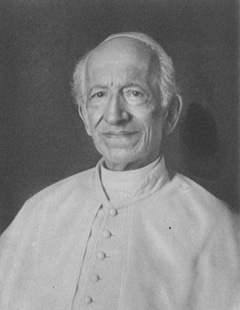
The one historical precedent I haven't seen mentioned, in print or on the radio, is the Kulturkampf, Bismarck's effort to marginalize the Catholic Church in Germany. It isn't fully parallel to the present-day Progressive agenda, and the Catholic Church in the US doesn't currently appear to be as unified against it as it was in late 19th century Germany. However, the consensus appears to be that Pope Leo XIII's strong leadership resolved that particular issue. Since I've become Catholic, I've slowly learned more about Leo XIII. I get the impression that he was a strong Pope along the lines of John Paul II.
We know the Enemy won't prevail. We can trust that the Holy Spirit will send us the leadership we need when we need it.
Monday, June 29, 2015
English Missal
Fr Hunwicke has begun a series of posts on the Anglo-Papalist English Missal on his blog. I will be following with great interest.
Subscribe to:
Posts (Atom)